_edited.png)
_edited.png)
When Courts Start Pricing Liberty: Supreme Court Says Anticipatory Bail or Regular Bail Cannot Be Conditional on Payment

-by Atul Singh, Advocate
An important question came before the Supreme Court: Can bail be granted only if money is paid? The Hon’ble Supreme Court has once again answered this question in the negative, drawing a clear line between the judicial discretion to grant bail and the increasingly visible practice of using bail proceedings as a tool for recovery or leverage.
In Prantik Kumar & Anr. v. State of Jharkhand & Anr., the Hon’ble Supreme Court reiterated a principle central to criminal jurisprudence that personal liberty cannot be made conditional on financial capacity.
The judgment addresses a growing and troubling trend, particularly in cases arising out of commercial and financial disputes, where courts link the grant of bail or anticipatory bail with payment or deposit of disputed amounts.
Brief Facts in the Anticipatory Bail
The case arose out of a commercial transaction. Alleging non-payment of certain dues, the complainant lodged an FIR invoking Sections 406, 420, 504, 506 and 120B read with Section 34 of the IPC.
Apprehending arrest, the accused persons, i.e., father and son, approached the Sessions Court and thereafter the Jharkhand High Court seeking anticipatory bail in the FIR registered against them.
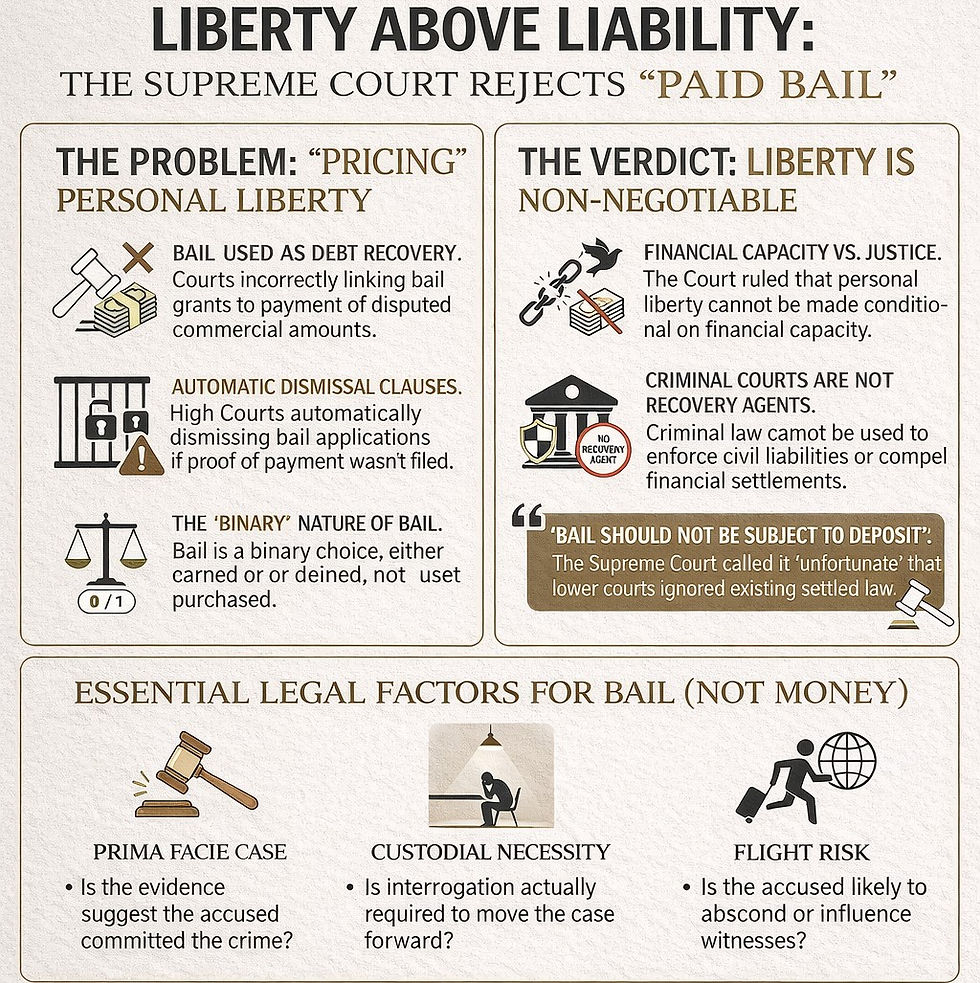
Instead of examining whether custodial interrogation was necessary or whether the accused deserved protection from arrest, the High Court directed them to file supplementary affidavits showing payment of the alleged outstanding amount. The orders further stated that if proof of payment was not filed within the stipulated time, the bail applications would stand dismissed automatically.
Aggrieved by these directions, the accused approached the Supreme Court.
Issue Before the Hon’ble Supreme Court
Whether a court can make payment or deposit of money a condition precedent for the grant of bail or anticipatory bail??
Findings of the Hon’ble Supreme Court
While setting aside the High Court’s order, the Hon’ble Supreme Court held that bail or anticipatory bail cannot be made subject to payment or deposit of money. The Court expressed its disapproval of the approach adopted by the High Court, particularly since the issue was already settled by earlier judgments of the Supreme Court.
The Court observed:
“It is very unfortunate that despite this Court saying in so many words that grant of regular bail or the anticipatory bail should not be subject to deposit of any amount, the High Court has said that the petitioners should deposit the balance amount…”
Reiterating the correct approach to bail, the Court further held:
“If a case for grant of bail or anticipatory bail is made out, then the Court should proceed to pass an appropriate order and if not made out, the Court may decline; however, the Court should not pass a conditional order of deposit of a particular amount and then exercise its discretion.”
Ultimately, the Court directed that, in the event of arrest, the petitioners shall be released on bail subject to appropriate conditions.
Analysing the Reasoning of the Hon’ble Supreme Court
The reasoning of the Supreme Court is firmly rooted in settled bail jurisprudence. At the stage of bail, a criminal court is required to consider limited factors as to whether a prima facie case exists and custodial interrogation is necessary, whether the accused is likely to abscond, or whether there is a risk of tampering with evidence or influencing witnesses.
Payment of alleged dues has no nexus with any of these considerations. By directing the deposit of money as a condition for bail, courts effectively convert bail proceedings into recovery proceedings. The Hon’ble Supreme Court made it clear that criminal courts are not meant to enforce civil liabilities or compel settlement through the threat of arrest.
Bail operates in binary terms. Either a case for bail is made out, or it is not. Liberty cannot be kept in abeyance pending compliance with a financial condition.
This is not the first occasion on which the Hon’ble Supreme Court has flagged this issue. In Gajanan Dattatray Gore v. State of Maharashtra & Anr., the Court had already held that bail cannot be granted subject to the deposit of money, and that such conditions amount to the misuse of the criminal process for the recovery of dues.
This judgment addresses a reality encountered regularly in practice. In disputes with a financial or commercial element, criminal proceedings are often initiated to exert pressure, and bail hearings become the point at which that pressure is applied. The Supreme Court has reaffirmed that courts cannot participate in this process by pricing liberty.
Bail exists to protect personal liberty pending trial. It is not meant to recover money, enforce contracts, or compel settlement.
Case Details
Prantik Kumar & Anr. v. State of Jharkhand & Anr.
SLP (Crl.) Diary No. 4297 of 2026
Order dated: 3 February 2026
Bench: Justice J.B. Pardiwala and Justice K.V. Viswanathan
Read Judgment:



Comments