_edited.png)
_edited.png)
Bail in Economic Offences

By Atul Singh, Advocate
One of the most common questions asked by individuals facing investigation by the Enforcement Directorate (ED), Central Bureau of Investigation (CBI), Economic Offences Wing (EOW), Serious Fraud Investigation Office (SFIO), Income Tax Department, GST authorities, or local police is:
"Is bail difficult in economic offences?"
The short answer is yes, but the complete answer is far more nuanced.
Over the last two decades, Indian courts have repeatedly observed that economic offences stand on a different footing from ordinary criminal offences. Allegations involving bank fraud, money laundering, corporate fraud, GST fraud, cheating of investors, diversion of funds, embezzlement, corruption, and financial scams are often viewed more seriously because their impact extends beyond a single victim and may affect public confidence in the financial system itself.
At the same time, courts have also repeatedly emphasised that the seriousness of allegations alone cannot become a substitute for evidence, nor can it justify indefinite incarceration.
The law, therefore, attempts to strike a balance between two competing interests:
The need to investigate and prosecute serious financial crimes; and
The constitutional right to personal liberty.
This balance lies at the heart of modern bail jurisprudence in economic offences.
What Is an Economic Offence?
There is no single statutory definition that covers every economic offence. Broadly speaking, economic offences are crimes involving financial gain through unlawful means.
Common examples include:
Bank fraud
Corporate fraud
Cheating and criminal breach of trust
Money laundering
GST fraud
Tax evasion
Investment scams
Ponzi schemes
Embezzlement of funds
Misappropriation of public money
Corruption offences
Financial irregularities involving companies and institutions
Many such cases are investigated by specialised agencies such as the ED, CBI, SFIO, EOW, Income Tax authorities, GST authorities, or Anti-Corruption Bureaus.
Why Do Courts Treat Economic Offences Differently?
The Supreme Court has repeatedly observed that economic offences affect the economic fabric of society. Unlike a private dispute between two individuals, large-scale financial fraud often has wider consequences.
A bank fraud may affect depositors.
A corporate scam may affect shareholders.
A Ponzi scheme may affect thousands of investors.
Diversion of public funds may affect public welfare projects.
For this reason, courts frequently describe economic offences as serious offences requiring careful scrutiny while considering bail.
However, it is equally important to understand that "serious" does not mean "bail must be refused."
The seriousness of allegations is only one factor among many.
Does an Economic Offence Automatically Mean Bail Will Be Rejected?
No.
There is no rule in Indian law that states that a person accused of an economic offence cannot be granted bail.
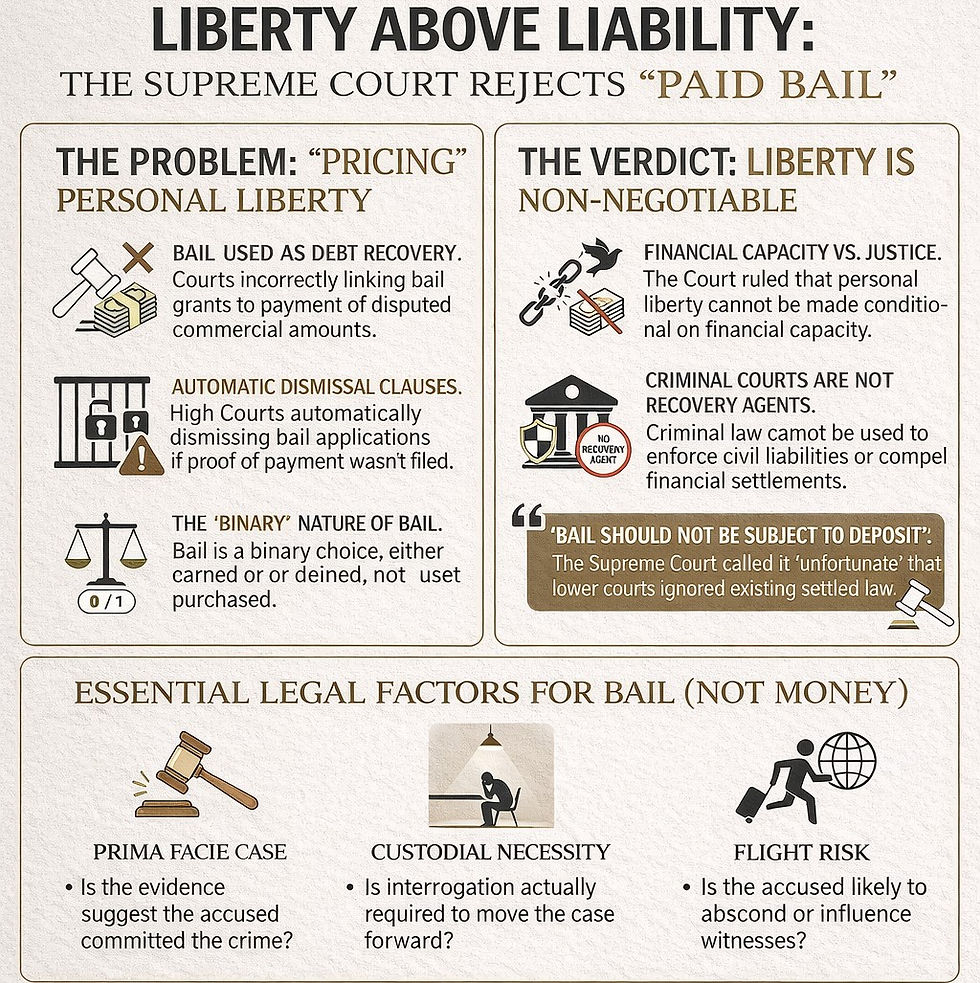
The Supreme Court has consistently held that every bail application must be decided on its own facts and circumstances. Courts do not decide bail merely on the label attached to the offence.

Instead, they examine factors such as:
Nature of allegations
Amount involved
Stage of investigation
Evidence collected
Possibility of tampering with evidence
Possibility of influencing witnesses
Likelihood of absconding
Length of incarceration
Filing of chargesheet
Conduct of the accused
The ultimate question remains whether continued custody is necessary.
Why Are Courts More Cautious in Economic Offences?
Although bail is not automatically refused, courts often exercise greater caution in financial crime cases. This caution generally stems from practical considerations.
Possibility of Influencing Witnesses
Economic offences are frequently committed by individuals holding positions of authority, influence, or financial strength.
Investigating agencies often argue that such persons may influence witnesses or interfere with the investigation if released prematurely.
Courts, therefore, carefully examine the possibility of witness tampering before granting bail.
Documentary and Complex Investigations
Unlike conventional criminal cases, financial crimes often involve:
Company records
Bank accounts
Audit reports
Electronic data
Financial transactions
Multiple entities and shell companies
Layered transactions
Investigations can therefore become highly complex. Courts sometimes consider whether custodial interrogation is necessary to uncover the complete financial trail.
Flight Risk
One concern repeatedly raised in economic offence cases is the possibility of the accused leaving the country.
Where allegations involve large sums of money and substantial financial resources, investigating agencies often argue that the accused may abscond.
However, courts have repeatedly clarified that "flight risk" cannot be presumed merely because an allegation involves money.
The assessment must be based on the facts of the particular case.
In many cases, courts address such concerns through conditions such as:
Surrender of the passport
Travel restrictions
Periodic appearance before investigating agencies
Influence Arising from Position and Status
In some cases, the accused may occupy influential positions in business, politics, administration, or corporate management.
Courts sometimes consider whether such influence could interfere with the investigation or prosecution.
Again, this is a factual assessment and not an automatic ground for refusal of bail.
What Is Custodial Interrogation and Why Does It Matter?
One phrase frequently encountered in economic offence litigation is "custodial interrogation."
Investigating agencies often argue that financial crimes involve layers of transactions, multiple entities, complex structures, and concealed assets.
They therefore seek custody of the accused for effective investigation.
Courts have recognised that custodial interrogation may, in appropriate cases, be relevant for uncovering financial trails and tracing proceeds of crime.
This is one reason why anticipatory bail is often examined more cautiously in economic offences.
Is Anticipatory Bail Difficult in Economic Offences?
Generally speaking, yes. Courts often exercise greater caution while considering anticipatory bail in serious economic offences.
The reason is simple. At the pre-arrest stage, investigation may still be underway. Investigating agencies frequently contend that custodial interrogation is necessary.
The Supreme Court has on multiple occasions observed that anticipatory bail in complex financial investigations should be granted only after careful consideration of the facts of the case.
However, there is no blanket prohibition.
Where allegations appear exaggerated, motivated, unsupported by material, or where custodial interrogation is genuinely unnecessary, courts may still grant anticipatory bail.
Does Filing of Chargesheet Improve the Chances of Bail?
In many cases, yes.
Once the investigation is substantially complete and the chargesheet has been filed, several concerns that justified continued custody may become less significant.
For example:
Documentary evidence may already be seized.
Witness statements may already be recorded.
Financial records may already be secured.
The investigation may be substantially completed.
This does not automatically entitle an accused to bail, but it often becomes an important factor in favour of release.
Can Bail Be Granted Even in Large Financial Fraud Cases?
Yes.
The amount involved, by itself, is not the sole criterion.
Indian courts have repeatedly granted bail in cases involving substantial financial allegations where the surrounding circumstances justified release.
The courts generally consider:
Whether the investigation is complete.
Whether the accused has cooperated;
Whether the evidence is documentary in nature;
Whether further custody serves any meaningful purpose; and
Whether the trial is likely to take considerable time.
The criminal justice system is not intended to punish a person before conviction.
What Role Does Personal Liberty Play?
Every bail application ultimately returns to a fundamental constitutional principle.
A person accused of an offence remains presumed innocent until proven guilty.
Pre-trial detention cannot become a substitute for punishment.
Courts, therefore, constantly balance:
The seriousness of allegations; and
The constitutional guarantee of personal liberty.
Neither consideration can completely override the other.
This balancing exercise lies at the heart of every bail decision.
Frequently Asked Questions
Is bail harder in economic offences?
Generally, courts exercise greater caution in economic offences because of the nature of allegations, the complexity of investigations, and the possibility of influencing witnesses.
Can anticipatory bail be granted in economic offences?
Yes. However, courts often scrutinise such applications more carefully, particularly where custodial interrogation is claimed to be necessary.
Does filing of a chargesheet improve the chances of bail?
In many cases, the filing of the chargesheet becomes a relevant factor because the investigation is substantially complete.
Can ED cases result in bail?
Yes. Bail is regularly granted in appropriate cases depending upon the facts, evidence, statutory requirements, and stage of proceedings.
Are economic offences treated differently from ordinary crimes?
Courts often regard economic offences as a distinct category because of their potential impact on society and the economy. However, the principles governing bail continue to apply.
Does a large financial allegation automatically mean bail will be refused?
No. The amount involved is only one factor. Courts examine the entire factual matrix before deciding a bail application.
Final Thoughts
There is no doubt that courts approach economic offences with greater caution than many conventional criminal cases. Financial frauds, money laundering allegations, corruption cases, corporate scams, and investment frauds often involve large sums of money, complex investigations, and broader societal consequences.
However, it would be equally incorrect to assume that bail is impossible in such matters.
The law remains clear that every bail application must be decided on its own facts. Seriousness of allegations is undoubtedly relevant, but it cannot replace evidence, nor can it justify automatic denial of liberty.
Ultimately, the courts attempt to balance the interests of investigation, the rights of victims, the integrity of the criminal justice process, and the constitutional rights of the accused. It is this balancing exercise that determines whether bail should be granted in a particular economic offence case.


Comments