_edited.png)
_edited.png)
Understanding Bail in Criminal Law: A Comprehensive Guide

Updated: Aug 20
The law relating to bail occupies a central position in criminal litigation. It is an important stage requiring detailed deliberation on both facts and law, as the courts are required to balance the constitutional value of personal liberty with the legitimate interests of investigation and trial.
Whether the accused is entitled to bail depends on the specifics of each case, as every case turns on its own facts. No rigid formula can determine whether bail should be granted or refused.
One of the first questions that arises after the registration of an FIR is not whether the allegations are true or false. The first question is usually much simpler: "Can I be arrested?" The second question follows immediately: "Can I get bail?"
For most individuals, their first interaction with the criminal justice system is frightening. A phone call from the police, a notice, a complaint, information from a relative, or knowledge that an FIR has been registered is often enough to create panic. Many people assume that the registration of an FIR automatically means jail. That is not the law. Not every FIR leads to an automatic arrest. The purpose of arrest is not punishment. The arrest after the registration of an FIR is not to punish the accused, as a person accused of an offence is presumed innocent unless proven guilty before a court of law.
The sentencing and punishment follow conviction, which can only be determined after a full-fledged trial. Bail concerns the period before conviction.
This distinction is extremely important because criminal trials often take years to conclude. Investigations may continue for months. Chargesheets may contain hundreds or thousands of pages. Witnesses may have to be examined over several years. If every accused person were required to remain in custody until the completion of trial, the constitutional guarantee of personal liberty would become meaningless.
This is where the law of bail assumes importance. Whether the issue involves anticipatory bail, regular bail, interim bail, transit bail, cancellation of bail, modification of bail conditions, delay in trial, or prolonged incarceration, the underlying question remains the same: Can the objectives of justice be achieved without continued detention?
What Is Bail?
In simple terms, bail is the release of a person from custody upon such conditions as may be imposed by the Court. Instead of remaining in jail during investigation or trial, the accused is permitted to remain at liberty while continuing to participate in the criminal proceedings. The purpose of bail is not to declare the accused innocent in the same manner as his/her custody was not to punish him.
As stated above, criminal cases often take years to conclude. Investigations may continue for months. Numerous witnesses may have to be examined, and voluminous documents may have to be proved. If every accused person were required to remain in custody until the completion of trial, a person could spend years in prison before being found guilty or innocent. The law, therefore, permits release on bail in appropriate cases.
Courts have repeatedly emphasised that bail is concerned with securing the presence of the accused during investigation and trial, not with punishing him.
BAIL is the RULE. JAIL is an EXCEPTION.
Does Rejection of Bail Mean the Accused Is Guilty?
No. A court deciding a bail application is not conducting a trial. The court is not determining guilt or innocence. The court is merely deciding whether custody should continue at that particular stage of the proceedings. A person whose bail is rejected may ultimately be acquitted. Similarly, a person whose bail is granted may ultimately be convicted.
The issue of bail and the issue of guilt are entirely different.
Is Bail a Right?
It depends upon the nature of the offence and the facts of the case. Indian penal provisions are classified under two heads: Bailable and Non-Bailable.
In bailable offences, bail is available as a matter of right.
In non-bailable offences, bail is granted at the discretion of the court after considering the facts of the case.
Types of Bail Under Indian Law
Broadly speaking, the most common forms of bail are:
1. Anticipatory Bail
Anticipatory Bail is sought before arrest when a person apprehends that he may be arrested in a non-bailable offence.
2. Regular Bail
Regular Bail is sought after a person has been arrested and is in custody. One may also encounter terms like Interim Bail/Interim protection or Transit Bail.
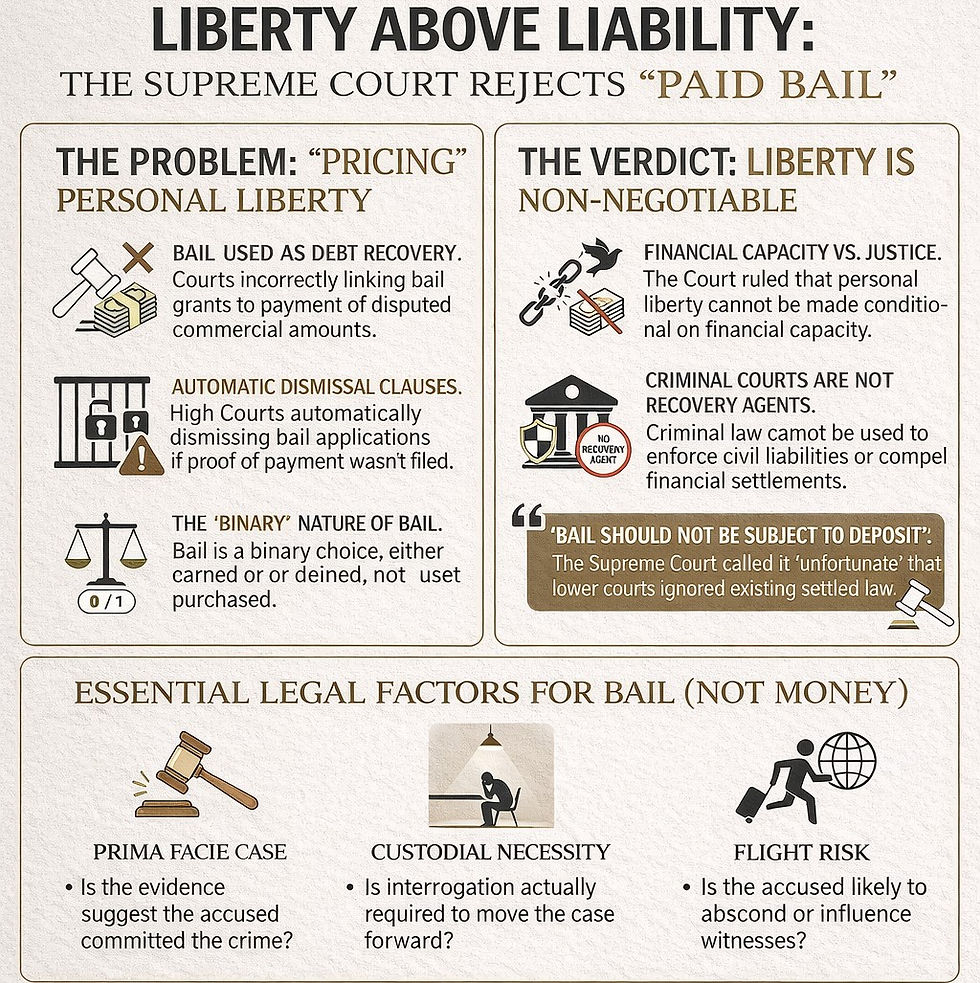
What Factors Do Courts Consider While Granting Bail?
At the time of deciding the bail application, the courts generally consider:
Nature and gravity of allegations
Role attributed to the accused
Possibility of absconding
Likelihood of witness intimidation
Requirement of custodial interrogation
Criminal antecedents
Stage of investigation
Filing of chargesheet
Length of incarceration
No single factor is decisive. Every case depends upon its own facts and circumstances.
Constitutional Foundation of Bail under Article 21
To understand the law of bail, it is first necessary to understand the constitutional philosophy that underlies it. Bail is not merely a procedural remedy found in criminal statutes. It is deeply connected with one of the most important guarantees contained in the Constitution of India, i.e. the right to life and personal liberty.
The law relating to bail derives much of its strength from Article 21 of the Constitution, which provides that no person shall be deprived of his life or personal liberty except according to procedure established by law.
The law of bail operates directly within this constitutional framework. Whenever a Court is called upon to decide a bail application, it is essentially balancing two competing interests. On one side lies the individual's right to personal liberty, and on the other side lies society's interest in ensuring a fair investigation, securing the presence of the accused, protecting witnesses, preserving evidence, and maintaining confidence in the administration of criminal justice.
Personal Liberty Is a Constitutional Right
The Constitution recognises personal liberty as one of the most cherished rights available to an individual. Loss of liberty is among the most serious consequences that can be imposed upon a person. Arrest affects not only freedom of movement but also family life, employment, reputation, social standing, business interests, and mental well-being.
The consequences of incarceration frequently extend beyond the walls of a prison. A person may lose employment or his/her businesses may suffer; families may experience financial hardship, etc. In many cases, the damage caused by incarceration cannot be fully reversed even if the accused is ultimately acquitted after trial.
It is for this reason that courts consistently emphasise that deprivation of liberty must be justified by legitimate legal necessity, as the criminal process cannot become a punishment in itself.
One of the foundational principles of criminal jurisprudence is the presumption of innocence. Every person accused of an offence is presumed innocent until proven guilty before a competent court of law. This principle is not merely a technical rule. It forms the foundation upon which the entire criminal justice system rests.
The law of bail is closely connected with this principle. If every accused person were required to remain incarcerated until completion of trial, the presumption of innocence would lose much of its practical significance. The concept of bail, therefore, seeks to preserve personal liberty while ensuring that the accused remains available to face investigation and trial.
The above-quoted principles in bail jurisprudence that "bail is the rule and jail is the exception" reflect the constitutional preference for liberty over unnecessary detention.
However, this expression does not mean that every accused person is automatically entitled to bail. Nor does it mean that courts should ignore the seriousness of allegations. Rather, it signifies that incarceration before conviction should ordinarily be justified by specific circumstances and not imposed mechanically.
The constitutional significance of bail becomes particularly evident when viewed in the context of arrest. Arrest is one of the most intrusive powers available to the State. It involves a direct interference with personal liberty.
For this very reason, courts have repeatedly emphasised that arrest cannot become a routine or mechanical exercise. Merely because arrest is legally permissible does not mean that arrest is always necessary. Courts, therefore, scrutinise whether custodial detention is genuinely required for the purposes of investigation. This constitutional concern has played a significant role in the development of anticipatory bail jurisprudence and judicial safeguards against arbitrary arrests.
Speedy Trial and Bail
Perhaps one of the most significant contributions of Article 21 to criminal law is the recognition of the right to a speedy trial. The Constitution does not expressly use the phrase "speedy trial." However, judicial interpretation has consistently recognised that an unreasonably delayed trial violates the guarantee of personal liberty.
Prolonged incarceration and undue delay are important factors that are considered by the Courts while deciding bail applications. The longer the delay, the stronger the constitutional concerns become, as the criminal process cannot be permitted to become a substitute for punishment.
In recent years, courts have repeatedly expressed concern regarding undertrial prisoners who spend substantial periods in custody before the conclusion of trial. This issue becomes particularly significant in cases involving complex investigations, large numbers of witnesses, voluminous records, and lengthy trials. Even where allegations are serious, courts have increasingly recognised that prolonged incarceration without conclusion of trial may raise concerns under Article 21.
What Factors Do Courts Consider While Granting Bail?
There is no straightjacketed formula or checklist for deciding whether bail should be granted or not. Every bail application is decided on its own facts and circumstances. However, over the years, certain considerations have consistently guided courts while exercising their discretion.
The court is not expected to conduct a mini-trial at the stage of bail, yet it cannot ignore the material available on record. The objective is to determine whether continued custody is necessary or whether the accused can be permitted to remain at liberty while the investigation or trial proceeds. Some of the most important factors considered by courts are discussed below.
I. Nature and Gravity of Allegations
The seriousness of the allegations is often one of the first aspects examined by the court. An allegation involving a simple scuffle resulting in minor injuries may stand on a completely different footing from allegations involving murder, rape, terrorism, organised crime, narcotics trafficking, corruption, or large-scale financial fraud.
However, the gravity of the offence is not determined merely by the section mentioned in the FIR. Courts often look beyond the statutory provision and examine the actual allegations. Two cases registered under the same penal provision may present entirely different factual situations.
For instance, a cheating case involving a private monetary dispute may be viewed differently from a case involving a fraudulent investment scheme affecting hundreds of investors. Similarly, allegations of criminal breach of trust involving a family dispute may stand differently from allegations involving public funds.
The seriousness of the accusation is, therefore, an important consideration, but it is never the sole consideration.
II. Role Attributed to the Accused
In cases involving multiple accused persons, the court carefully examines the specific role assigned to each individual. Merely because several persons are named in an FIR does not mean that they stand on an identical footing. One accused may be alleged to be the principal perpetrator, while another may be alleged to have played only a peripheral role.
In conspiracy cases, economic offences, matrimonial disputes, corporate frauds, and organised crime prosecutions, the distinction between a prime accused and a secondary participant often becomes significant. Courts, therefore, frequently analyse the precise allegations against the applicant seeking bail.
III. Possibility of Absconding
The criminal justice system can function effectively only if the accused remains available to face investigation and trial. A court deciding on the question of bail, therefore, examines whether there exists a genuine likelihood that the accused may evade the legal process if released.
This assessment is not based on speculation. Courts often look at practical considerations such as permanent residence, business interests or employment, previous conduct during investigation, etc.
An accused who has deep roots within the community, stable employment, and a permanent residence may be viewed differently from a person who frequently changes locations, has no fixed place of residence, or has previously avoided legal proceedings.
People have concerns about the probable travel restrictions upon registration of FIR. The concern is not whether the accused can travel. The concern is whether the accused is likely to disappear and become unavailable for investigation or trial. Any restriction placed by the Court would be on a fair assessment of this factor and the facts and circumstances of the said case.
IV. Likelihood of Witness Intimidation
Witnesses form the backbone of any criminal prosecution. Where the prosecution alleges that witnesses may be vulnerable to pressure, threats, or influence, courts often proceed with caution. This factor assumes greater significance where the accused holds a position of power or influence or may cause intimidation of the witnesses where previous allegations of intimidation have been made.
In some cases, the apprehension may be genuine and supported by material on record. In others, it may be merely speculative. The court, therefore, assesses whether there exists a real possibility that the release of the accused may interfere with the ability of witnesses to depose freely and truthfully.
V. Requirement of Custodial Interrogation
One of the most frequently debated issues in bail proceedings is whether custodial interrogation is genuinely required. Investigating agencies often oppose bail on the ground that custody is necessary to recover stolen/case property, trace proceeds of crime, identify or apprehend co-accused persons, verify financial transactions, uncover the larger conspiracy, etc.
At the same time, courts have repeatedly recognised that arrest should not become a routine investigative tool. The real question is whether meaningful investigation can continue without taking the accused into custody.
In cases involving documentary evidence already seized by the investigating agency, the requirement of custodial interrogation may be viewed differently from cases involving recoveries yet to be made or conspiracies yet to be unravelled.
This factor frequently becomes decisive, particularly in anticipatory bail matters.
VI. Criminal Antecedents
The previous conduct of the accused is often examined while considering a bail application. If an accused has a history of involvement in similar offences, previous convictions, or repeated criminal cases, the court may consider such circumstances relevant while assessing the overall risk associated with release.
However, the mere existence of prior cases does not automatically justify rejection of bail. Many criminal cases ultimately result in acquittal, discharge, or closure. Courts, therefore, generally examine the nature of the antecedents, their relevance to the present allegations, and the stage of those proceedings before attaching significance to them.
Similarly, the absence of criminal antecedents often operates as a favourable circumstance, particularly where the accused has no previous interaction with the criminal justice system.
VII. Stage of Investigation
The necessity of custody frequently changes as the investigation progresses. At the initial stages of investigation, the police may still be collecting evidence, identifying witnesses, analysing electronic records, and conducting recoveries.
During this period, the investigating agency may contend that custody remains necessary. As the investigation progresses, however, many of these concerns diminish.
Once witness statements have been recorded, documents have been seized, electronic evidence has been secured, and recoveries have been effected, the justification for continued detention often becomes less compelling.
Courts, therefore, routinely examine the stage at which the bail application is being considered. The requirements of investigation at the beginning of a case are often very different from the requirements after substantial investigation has already been completed.
VIII. Filing of Chargesheet
The filing of a chargesheet is frequently treated as an important milestone in criminal proceedings. By the time a chargesheet is filed, the investigating agency has ordinarily completed its investigation and crystallised its allegations. The prosecution has identified its witnesses, collected the documents it seeks to rely upon, and formulated its case against the accused.
While filing of a chargesheet does not automatically entitle an accused to bail, it often weakens arguments based upon the need for continued investigation.
The court may ask a practical question: if the investigation is complete and the prosecution has already gathered the evidence it intends to rely upon, what purpose will continued incarceration serve?
The answer to that question often influences the outcome of the bail application.
IX. Length of Incarceration
The amount of time already spent in custody is an increasingly important consideration in modern bail jurisprudence. As discussed above, criminal trials frequently take years to conclude. Cases involving numerous witnesses, voluminous documents, expert evidence, or multiple accused persons may take even longer.
Courts have repeatedly expressed concern that an undertrial should not spend an unduly long period in custody before guilt has been established. The significance of this factor becomes particularly apparent where no substantial progress has been made in the trial proceedings or a large number of witnesses remain to be examined, making the early conclusion of proceedings unlikely.
In such situations, prolonged incarceration itself may become a substantial consideration while deciding whether continued detention remains justified.
X. Conduct After Registration of FIR
Courts frequently examine what the accused did after becoming aware of the criminal case or after being served with notice by the investigating officer. Whether the accused joined the investigation, responded to notices, and cooperated in the investigation becomes an important factor to be considered. An accused who disappeared, chose not to respond to the notices issued by the investigating officer, or did not extend cooperation in the investigation process may lead to denial of his/her anticipatory bail.
What Is Anticipatory Bail?
Anticipatory Bail is a pre-arrest legal protection granted by a court to a person who apprehends arrest in connection with a non-bailable offence. In simple terms, it is an order that if the police seek to arrest the applicant in the concerned case, the applicant shall be released on bail subject to the conditions imposed by the court.
Unlike Regular Bail, which is sought after arrest, Anticipatory Bail is sought before a person is taken into custody. The object of the provision is not to shield offenders from investigation. Rather, it is to protect individuals from unnecessary arrest while ensuring that the investigation proceeds in accordance with law.
When Can a Person Apply for Anticipatory Bail?
A person may seek Anticipatory Bail when there exists a genuine apprehension of arrest in connection with a non-bailable offence. The apprehension must be real and based upon identifiable circumstances. Courts generally do not entertain speculative fears unsupported by any material.
Applications commonly arise in situations where an FIR has been registered under non-bailable sections. The law does not require an applicant to wait until the police arrive at his doorstep. If circumstances indicate a genuine possibility of arrest, the remedy may be invoked.
Can Anticipatory Bail Be Sought Before Registration of an FIR?
Yes. One of the most common misconceptions is that an FIR must necessarily be registered before an application for Anticipatory Bail can be filed. The law does not impose such a rigid requirement.
There may be situations where a person becomes aware that criminal proceedings are likely to be initiated. A complaint may already have been filed. Notices may have been issued. The complainant may openly threaten criminal action. Family disputes or commercial disputes may have escalated to the point where criminal proceedings appear imminent.
If the applicant can demonstrate a genuine apprehension of arrest, the court may entertain the application even before formal registration of an FIR. The focus is not merely on the existence of an FIR but on the existence of a real apprehension of arrest.
Does Anticipatory Bail Stop Investigation?
No. This is perhaps the most frequently misunderstood aspect of Anticipatory Bail. An order granting Anticipatory Bail does not terminate the criminal case or a stay on the investigation. The only protection granted by the court is against custodial arrest.
The applicant remains obligated to cooperate with the investigation and comply with all lawful directions issued by the investigating agency.
Can Anticipatory Bail Be Granted in Serious Offences?
Yes. The seriousness of allegations is undoubtedly relevant, but there is no absolute rule that Anticipatory Bail cannot be granted in serious offences. Courts examine the facts of each case individually.
The nature of evidence, the role of the applicant, the requirement of custody, and the progress of the investigation often become more important than the mere label attached to the offence. The ultimate question remains whether arrest is genuinely necessary for the purposes of investigation.
Conditions Commonly Imposed While Granting Anticipatory Bail
Anticipatory Bail is often granted subject to conditions designed to protect the investigation. Common conditions include joining the investigation whenever required; cooperating with investigating authorities; furnishing contact details; not leaving the country without permission; not contacting or influencing witnesses; not tampering with evidence; informing authorities about changes in address; submitting the passport in appropriate cases; furnishing surety, etc.
The exact conditions vary from case to case depending upon the nature of allegations and the requirements of the investigation.
Can Anticipatory Bail Be Cancelled?
Yes. An order granting Anticipatory Bail is not immune from challenge. Courts retain the power to cancel protection where circumstances justify such action.
Cancellation may be sought where the accused violates conditions imposed by the court; attempts to influence witnesses; tampers with evidence; obstructs investigation in any manner; misuses the liberty granted or suppresses material facts while obtaining relief.
This power of cancellation exists to ensure that judicial protection is not abused.
Can Anticipatory Bail Continue After Filing of the Chargesheet?
In many cases, by the time the investigation concludes and the chargesheet is filed, the accused may already be enjoying protection under an Anticipatory Bail order. The filing of a chargesheet does not automatically result in cancellation of that protection.
What Is Regular Bail?
While Anticipatory Bail is sought before arrest, Regular Bail comes into the picture after a person has already been arrested and taken into custody.
The moment a person is arrested, a practical question arises: Can the accused be released from custody pending investigation or trial?
The answer to that question is determined through a Regular Bail application. In simple terms, Regular Bail is the release of an accused person from judicial or police custody upon such terms and conditions as may be imposed by the court.
The purpose of Regular Bail is not to decide whether the accused is guilty or innocent. That determination can only be made after trial. The court is merely required to decide whether continued detention is necessary at that particular stage of the proceedings.
Once a person is in custody, the remedy available is Regular Bail.
Why Is Regular Bail Important?
Arrest does not amount to conviction. A person may be arrested because the investigating agency believes that he is involved in the commission of an offence. However, the criminal justice system does not proceed on assumptions of guilt. The prosecution must still prove its case in accordance with law. Only thereafter can a court determine whether the accused is guilty.
Since this process may take considerable time, the law recognises that a person should not remain in custody indefinitely merely because allegations have been made against him. Regular Bail, therefore, serves as an important mechanism for balancing the needs of investigation with the rights of the accused.
What Happens After Arrest?
After arrest, the accused must ordinarily be produced before the jurisdictional Magistrate within twenty-four hours. The investigating agency may seek police custody for purposes of investigation.
The court may permit police custody where justified by the facts of the case and the requirements of the investigation. Thereafter, the accused may be remanded to judicial custody.
At any stage after arrest, the accused may seek Regular Bail in accordance with law. The court then examines whether continued detention remains necessary.
Modification of Bail Conditions
Grant of bail does not necessarily mean that the terms imposed by the court remain fixed forever. Circumstances often change after the grant of bail, and conditions that may have appeared reasonable at one stage of the proceedings may subsequently become impractical, unnecessary, or excessively burdensome.
For this reason, courts possess the power to modify, relax, delete, or clarify bail conditions where the interests of justice so require.
The law recognises that bail conditions are intended to secure the presence of the accused and protect the integrity of the proceedings. They are not intended to operate as a punishment or create unreasonable obstacles in the life of the accused.
Accordingly, where circumstances justify intervention, the accused may approach the appropriate court seeking modification of the conditions imposed while granting bail.

Frequently Asked Questions
Q. What is Anticipatory Bail in India?
Anticipatory Bail is a pre-arrest legal protection granted by a Court to a person who apprehends arrest in a non-bailable offence.
Q. How can I get Anticipatory Bail?
A person apprehending arrest may approach the Sessions Court or the High Court by filing an Anticipatory Bail application explaining the circumstances giving rise to the apprehension of arrest.
Q. Can Anticipatory Bail be granted before FIR is registered?
Yes. Courts have repeatedly held that registration of an FIR is not always a pre-condition for seeking Anticipatory Bail if there exists a genuine apprehension of arrest.
Q. Can police arrest me if I have Anticipatory Bail?
Once Anticipatory Bail is granted and remains operative, the accused is ordinarily protected from custodial arrest in relation to that case.
Q. How long does Anticipatory Bail remain valid?
The duration depends upon the terms of the order passed by the Court. In many cases, Anticipatory Bail continues till the conclusion of trial unless limited by the Court.
Q. Can Anticipatory Bail be cancelled?
Yes. Bail may be cancelled if liberty is misused, conditions are violated, witnesses are influenced, or the accused obstructs the administration of justice.
Q. Can Anticipatory Bail be granted in dowry cases?
Yes. Anticipatory Bail is frequently sought in matrimonial disputes involving allegations under Section 498A IPC and related provisions.
Q. Can Anticipatory Bail be granted in cheating cases?
Yes. Courts regularly consider Anticipatory Bail applications in cases involving allegations of cheating, breach of trust, and financial disputes.
Q. Can Anticipatory Bail be granted in economic offences?
Yes. However, courts often examine the necessity of custodial interrogation and the nature of the financial allegations before granting relief.
Q. What documents are required for Anticipatory Bail?
The exact documents depend upon the facts of the case, but generally include the FIR (if available), complaint, notices, supporting documents, and proof of identity.
Q. Can Anticipatory Bail be filed online?
The filing process depends upon the rules of the concerned court and local practice.
Q. Can Anticipatory Bail be filed in another State?
Jurisdiction depends upon the facts of the case and the location where the FIR has been registered.
Q. Can High Court grant Anticipatory Bail?
Yes. Both the Sessions Court and the High Court have jurisdiction to grant Anticipatory Bail.
Q. What happens if Anticipatory Bail is rejected?
The applicant may explore other legal remedies, including approaching a higher court.
Q. Is Anticipatory Bail available in every criminal case?
No. The availability of Anticipatory Bail depends upon the nature of allegations and the applicable statutory provisions.
Q. What is Regular Bail?
Regular Bail is sought after arrest when an accused person is already in custody.
Q. How can I get bail after arrest?
A bail application may be filed before the competent court seeking release from custody pending investigation or trial.
Q. How long does it take to get bail after arrest?
The timeline varies depending upon the nature of allegations, urgency of the matter, and court schedule.
Q. Can bail be granted after chargesheet is filed?
Yes. Filing of the chargesheet is often considered an important factor while deciding bail applications.
Q. Does filing of chargesheet guarantee bail?
No. Filing of the chargesheet is only one factor among many considered by the Court.
Q. Can bail be granted in non-bailable offences?
Yes. Non-bailable does not mean bail is impossible. It means bail is subject to judicial discretion.
Q. Can bail be granted in murder cases?
Depending upon the facts, evidence, and stage of proceedings, courts may grant bail even in serious offences.
Q. Can bail be granted in POCSO cases?
Yes. Courts consider the allegations, evidence, and applicable statutory provisions before deciding bail.
Q. Can bail be granted in NDPS cases?
Bail in NDPS matters is governed by special statutory provisions and additional restrictions may apply.
Q. Can bail be granted in economic offences?
Yes. Courts regularly consider bail applications in economic offences while balancing personal liberty and investigative interests.
Q. What happens after bail is granted?
The accused is released from custody subject to compliance with the conditions imposed by the Court.
Q. Can a person leave India after getting bail?
This depends upon the bail conditions. Permission of the Court may be required.
Q. What is a bail bond?
A bail bond is an undertaking executed pursuant to a bail order ensuring compliance with court directions.
Q. Who can become a surety in a bail case?
The suitability of a surety depends upon the requirements imposed by the Court.
Q. Does bail mean the case is over?
No. The criminal case continues despite the grant of bail.
Q. Can bail be cancelled after it is granted?
Yes. Courts possess the power to cancel bail where liberty is misused.
Q. Who can apply for cancellation of bail?
The prosecution, complainant, or any aggrieved party may seek cancellation in appropriate cases.
Q. On what grounds can bail be cancelled?
Witness intimidation, tampering with evidence, absconding, violation of bail conditions, and misuse of liberty are common grounds.
Q. Can bail be cancelled merely because the allegations are serious?
Generally, cancellation requires supervening circumstances or misuse of liberty after the grant of bail.
Q. Can bail conditions be modified?
Yes. Courts may relax, modify, or delete conditions where circumstances justify such relief.
Q. Can travel restrictions imposed in bail orders be removed?
Yes. Courts frequently consider such applications depending upon the facts of the case.
Q. Can passport be returned after grant of bail?
Depending upon the facts and stage of proceedings, courts may permit the return of the passport.
Q. Can reporting conditions be relaxed?
Where circumstances change, courts may consider modification of reporting requirements.
Q. Can a higher court modify bail conditions?
Yes. Appropriate relief may be sought before the competent higher court.
Q. What happens if bail conditions are violated?
Violation may result in cancellation of bail and other legal consequences.
Q. Can police arrest immediately after an FIR?
Registration of an FIR does not automatically mean arrest. The necessity of arrest depends upon the facts of the case.
Q. Can police arrest without a warrant?
Yes. In many cognizable offences, police have statutory power to arrest without obtaining a warrant.
Q. Can police call me for questioning without arresting me?
Yes. Investigation and arrest are separate concepts.
Q. Can I refuse to join an investigation?
Failure to cooperate with a lawful investigation may have legal consequences.
Q. What should I do if I receive a notice from police?
The appropriate course of action depends upon the facts of the case, and legal advice should be sought promptly.
Q. Can police seize my phone during investigation?
Depending upon the nature of allegations and investigative requirements, electronic devices may be seized in accordance with law.
Q. Can police seize my passport?
The answer depends upon the facts of the case and applicable legal provisions.
Q. Can an FIR be quashed after filing of chargesheet?
Yes. Courts possess powers to quash criminal proceedings even after filing of the chargesheet in appropriate cases.
Q. Can an FIR be quashed after cognizance is taken?
Yes. The power to quash is not automatically extinguished merely because cognizance has been taken.
Q. Can long delay in trial become a ground for bail?
Yes. Delay in trial and prolonged incarceration are frequently relied upon while seeking bail under Article 21 of the Constitution.
Final Thoughts
The law of bail is ultimately a balance between two competing considerations: the individual's right to personal liberty and the State's obligation to ensure a fair and effective criminal justice process. While the Constitution protects every person's liberty, that protection is not absolute. Equally, the mere registration of an FIR or filing of a criminal case does not justify unnecessary incarceration.
For litigants, one of the most important things to understand is that bail proceedings are often time-sensitive. Decisions taken in the initial stages of investigation frequently have a significant impact on the future course of the case. Prompt legal advice, proper preparation of documents, and a clear understanding of the applicable legal principles can often make a substantial difference.
Every criminal case presents unique challenges. What may be a strong ground for bail in one matter may carry little significance in another. For that reason, bail strategy should never be based on assumptions, internet rumours, or isolated court orders circulated on social media. Each case requires an independent assessment of facts, evidence, procedural developments, and the prevailing legal position.
If you are facing arrest, have received a notice from the police, are seeking Anticipatory Bail, Regular Bail, Transit Bail, modification of bail conditions, cancellation of bail, or are dealing with issues relating to prolonged incarceration and delay in trial, it is advisable to seek legal guidance at the earliest stage so that your rights remain adequately protected throughout the proceedings.


Comments